2023 AEA Community Seed Grant Final Report: Dr. Helena Ariño Rodríguez
May 29, 2026
It was August 15,2023 when we introduced Dr. Helena Ariño Rodríguez. Click here for the introductory post where we learned about Dr. Ariño, the study plans and how the project would help patients and families affected by AE.
In the 2023 AEA Community Seed Grant Final Report, Dr. Ariño explains the outcomes of the project, Automated detection of autoimmune encephalitis using artificial intelligence. (Final Report submitted August 30, 2025).
1. List the specific aims of your project and explain how they were met.
The primary objective of this project was to develop a model capable of classifying patients with autoimmune encephalitis using a multimodal approach that integrates tissue-based assays and clinical summaries. Secondary objectives included:
a) comparing the performance of the model with that of human experts;
b) identifying the most important clinical features influencing the model’s predictions; and
c) exploring text similarities between patients with antibody-associated autoimmune encephalitis and those with probable seronegative autoimmune encephalitis.
This is an ongoing project in which the primary aim has been partially achieved.
Text-based classification:
We trained an initial machine learning model using curated clinical summaries and laboratory data to predict anti-NMDAR encephalitis. After curation, the dataset included 757 confirmed anti-NMDAR encephalitis cases, 5,243 non-NMDAR cases, and 305 cases with insufficient information. Using scikit-learn, text was vectorized with TF-IDF, and the dataset was split into training (70%) and testing (30%). The following models were evaluated:
- Multinomial Naïve Bayes Classifier: Accuracy = 0.85, F1-score for encephalitis = 0.00
- Complement Naïve Bayes Classifier: Accuracy = 0.86, F1-score for encephalitis = 0.02
- Support Vector Machine: Accuracy = 0.85, F1-score for encephalitis = 0.57
Due to the class imbalance, the TF-IDF models showed limited ability to recall anti-NMDAR encephalitis cases. The next step is to implement state-of-the-art approaches, such as pretrained embeddings (e.g., BioBERT), to improve classification.
Image-based classification:
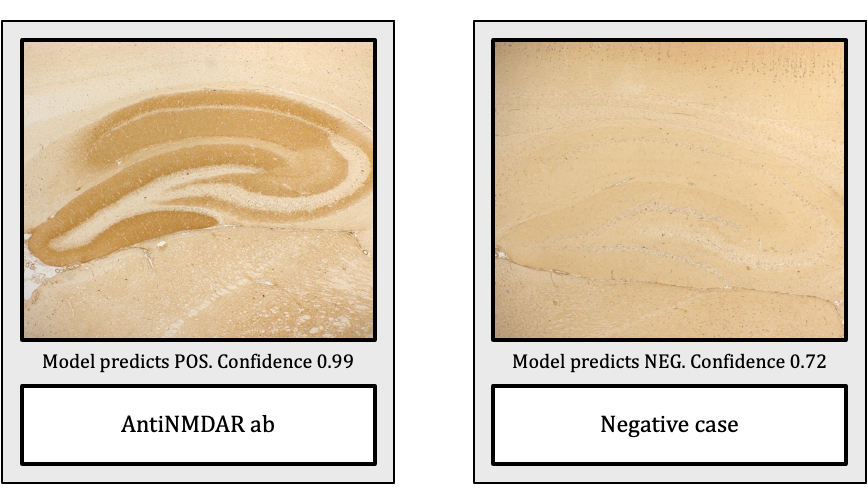
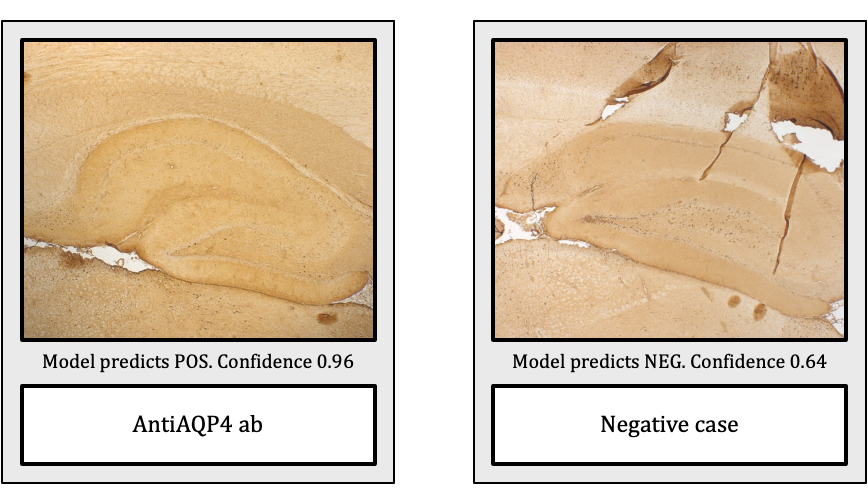
For the image analysis, we focused on immunohistochemistry (IHC) of the hippocampus. Images were split into training (803), validation (202), and test (10) sets. Labels were provided by an expert panel and binarized as positive or negative. Images were rescaled to 255 pixels. A convolutional neural network (CNN) built with TensorFlow achieved a validation loss of 0.3707 and validation accuracy of 0.8564. This model successfully classified hippocampal IHC samples as antibody-positive or negative with a robust confidence index.
Next steps:
- Extend image analysis to include cerebellar sections, which are also relevant for antibody detection.
- Develop a multimodal model integrating clinical summaries and IHC data.
- Pursue the secondary objectives related to clinical feature importance and subgroup analysis.
2. Describe the proposed impact/relevance of the project and the outcome.
The results of this ongoing study have the potential to significantly improve the early detection and diagnostic accuracy of autoimmune encephalitis, particularly in patients with neural autoantibodies.
First, automated prediction from clinical text—requiring no specialized laboratory techniques—could provide a remote screening tool to increase clinical suspicion of autoimmune encephalitis and trigger timely confirmatory testing, such as antibody assays.
Second, a computational model with performance comparable to or exceeding that of human experts may help reduce misdiagnosis, shorten the time to definitive diagnosis, and facilitate broader implementation of immunoassays. This would particularly benefit centers that are technically capable of performing the assays but lack extensive expertise in interpreting the results.
Currently, the evaluation of neural autoantibody testing is fully manual in reference laboratories. Our results provide a proof of concept that portions of this process could be automated, enabling greater standardization across centers, reducing inter-evaluator variability, and ultimately improving patient care.
3. Explain how the results of your project have direct implications for patients with AE.
At this stage of the project, there are no immediate direct implications for patients, as additional analyses and validation are required before translation into clinical practice. However, the preliminary results are promising and highlight the potential of these approaches to enhance diagnostic accuracy and reduce delays in diagnosis. Once validated, these tools could directly benefit patients with AE by supporting earlier recognition, guiding timely confirmatory testing, and ultimately improving access to appropriate treatment.
4. How did the AEA Community Seed Grant contribute to your ability to complete this project?
The AEA Community Seed Grant was instrumental in enabling this project. It provided the necessary resources to acquire a high-performance personal computer, which allowed me to conduct computationally intensive analyses locally. This support was particularly critical, as I had recently started a new position without any initial project funding.
In addition, the grant contributed significantly to my professional development by allowing me to advance a line of research that builds on my background in autoimmune encephalitis. It also enabled me to establish a project that highlights my interest in applying artificial intelligence to improve the diagnosis and management of autoimmune encephalitis and other autoimmune neurological conditions, thereby strengthening my academic profile and career trajectory.
I am deeply grateful to the Autoimmune Encephalitis Alliance (AEA) for awarding me the Community Seed Grant, which has been essential to the progress of this project and to the advancement of my research career.
Thank You, Thank You, Thank You!
Thank you, Dr. Ariño, for your research and your commitment to improving the lives of patients and families impacted by AE.
Thank you to the entire AE Alliance Community for contributing during the 2023 Research Network Month which assisted in funding this seed grant project.
Thank you for your contributions this year to fund future research!
Together, we are changing the course of AE.
