Research
Patients with AE often require care in an ICU. A group at Johns Hopkins led by Dr. John Probasco, discusses clinical presentation, diagnostic approaches, and treatment options for AE with particular focus on the central role the intensivist plays in this process. In a retrospective study at a tertiary referral center, 55% of patients meeting […]

In this nationwide cohort study, by De Bruijn and colleagues, the authors evaluated the seizure responses to immunotherapy and anti-epileptic drugs (AED’s) in patients with NMDAR, LGI1, and GABAbR encephalitis. The study included 153 patients with AE (53 LGI1, 75 NMDAR, 25 GABABR). Of those, 110 patients had epileptic seizures and were included in the […]

The blood-brain barrier (BBB) is a highly selective barrier formed by endothelial cells connected by tight junctions that separate circulating blood from the brain. An intact BBB prevents many micro- and macromolecules and immune cells from entering the brain in order to protect and maintain an optimal level of essential nutrients and neurotransmitters. There has […]
This week the FDA approved the initiation of a phase III clinical trial of the oncology supportive care drug Tocilizumab (Actemra – Genentech) for the treatment of hospitalized adult patients with severe COVID-19 pneumonia. Tocilizumab is a humanized anti-interleukin (IL)-6 receptor monoclonal antibody, which blocks IL-6-mediated signal transduction. Given the crucial role of IL-6 in stimulating […]
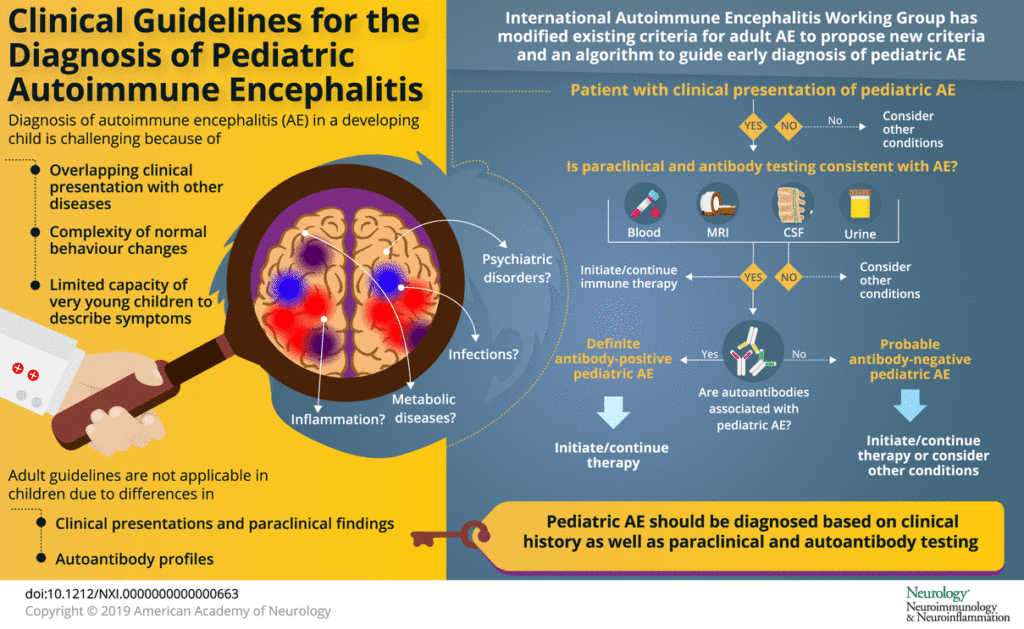
Autoimmune encephalitis (AE) is an important and treatable cause of acute encephalitis. Diagnosis of AE in a developing child is challenging because of overlap in clinical presentations with other diseases and the complexity of normal behavior changes. Existing diagnostic criteria for adult AE require modification to be applied to children, who differ from adults in […]
AE is often diagnosed by the detection of specific antibodies against different neuronal surface antigens in the cerebrospinal fluid (CSF), the blood or both. However, the antibody testing usually takes several days. A group at Ulm University in Germany reviewed the basic CSF findings of 1,305 patients with the 10 most important AE subtypes, for the […]

The American Academy of Child & Adolescent Psychiatry is holding its 66thAnnual Meeting, October 14-19 in Chicago, IL. On Wednesday, October 16, the focus will be on Autoimmune Brain Disorders. Autoimmune brain disorders are a spectrum of illnesses characterized by inflammation of the central nervous system (CNS). Child and adolescent psychiatrists must become familiar with […]

Early diagnosis of AE allows for aggressive treatment, which greatly improves recovery outcomes. On the contrary, delayed diagnosis and treatment can lead to permanent brain injury or even loss of life. In literature, no work has been published which compares clinical, radiological and laboratory characteristics of patients with definite autoantibody-positive AE (AE+) and autoantibody-negative AE (AE-). […]

We would like to invite all AE patients to participate in a study which surveys for symptoms following encephalitis. The study is being led by Dr. Venkatesan at Johns Hopkins University in collaboration with Dr. Yeshokumar at the Icahn School of Medicine at Mount Sinai. While encephalitis may result in the development of a number of persistent symptoms, […]
A group of researchers from the Autoimmune Neurology Group at the University of Oxford led by Dr. Sarosh Irani, recently published an article in the Lancet Psychiatry, noting that a focus on the psychopathology is likely the most effective way to promote prompt recognition of NMDAR-antibody encephalitis. NMDAR-antibody encephalitis is an autoantibody-mediated disease that typically presents […]