2024 AEA Edward Arditte Community Seed Grant Final Report: Dr. Nick Brenton
May 22, 2026
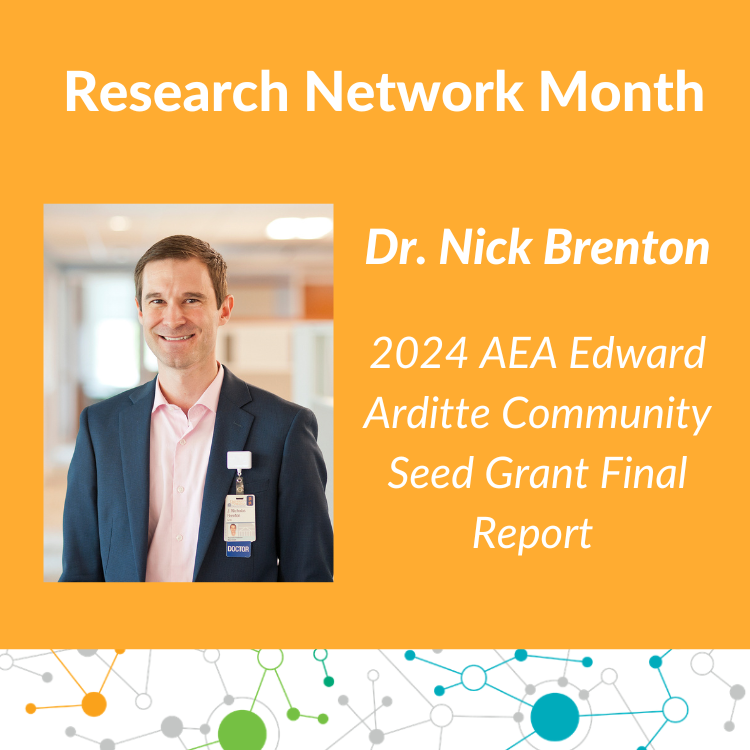
It was August 8, 2024 when we introduced Dr. Nick Brenton. Click here for the introductory post where we learned about Dr. Brenton, the study plans and how the project would help patients and families affected by AE.
In the 2024 AEA Community Seed Grant Final Report, Dr. Brenton explains the outcomes of the project, Capacity, Endurance, and Physical Activity in Children with MOG+Encephalitis. (Final Report submitted August 27, 2025.)
1. List the specific aims of your project and explain how they were met.
AIM 1: Assess the timed walking capacity of MOGAD subjects and controls using the 6-minute walk (6MW) test.
AIM 2: Assess the real-world physical activity (“behavior”) of MOGAD+AE subjects versus MOGAD+nonAE and controls using 7-day continuous accelerometry.
AIM 3: Identify clinical factors associated with reduced walking capacity and/or walking behavior in children with MOGAD+AE.
Our aims are listed above and are currently in process. Upon receipt of this seed grant, we began IRB submission (June 2024) and ultimately received approval from our IRB in February 2025. Our IRB approval was delayed due to the sensitive nature of the surveys (assessing mood/anxiety) and also due to our desire to include Spanish speaking subjects.
With the money provided by the AEA Seed grant, we were able to fund and ultimately train a summer medical student (Noel Getachew) to work on this project. To date, we have enrolled and completed study procedures on 11 MOG+ autoimmune encephalitis (AE) patients, 3 MOG + non AE (isolated optic neuritis or myelitis) patients, and 2 healthy controls. We currently have 2 MOG + AE patients consented and scheduled to complete the study and an additional 2 MOG + non-AE patients as well.
Our team had proposed to enroll 20 subjects in each cohort (20 MOG+AE patients, 20 MOG+nonAE patients, and 20 controls) – a project that was budgeted at $20,000. The AEA Seed Grant graciously awarded $5,000 dollars for funding, and thus, modifications to the original proposal were required to meet the amount ultimately awarded. After a discussion with AEA leadership, it was agreed that recruiting a cohort of 60 subjects was not financially feasible. Thus, our modified plan was to recruit 10 MOG+AE subjects, 10 MOG+nonAE subjects, and 10 healthy controls, unless we are able to identify further funding to support the original proposal.
2. Describe the proposed impact/relevance of the project and the outcome.
Despite apparent neurological recovery in the majority of children with MOGAD+AE, parents have persisting concerns about reductions in endurance at follow-up. In our experience, these concerns persist for years following a monophasic MOGAD+AE attack. There is a distinct lack of knowledge regarding the physical capacity and endurance of children with MOGAD+AE. Further, there is a paucity of knowledge denoting the real-world physical activity behaviors of these children. In this ongoing study, we are studying and will define potential impairments in physical capacity, endurance, and behavior that impact the every-day lives of children recovering from MOGAD (Aims 1 and 2).
If physical activity impairments are identified, this opens the door for future, next-step intervention studies to improve these impairments and assess the impact on long-term outcomes and quality of life. In order to define a next-step intervention, we must first understand the factors that associate and/or drive reductions in physical activity limitations (see our Aim 3).
3. Explain how the results of your project have direct implications for patients with AE.
Reduced physical activity levels are common in children with chronic disease. Importantly, higher levels of physical activity are known to have positive health effects within the general population (e.g., reduced incidence of obesity/metabolic syndrome, cerebrovascular disease, cognitive decline, and depression) which in turn results in lower mortality rates. While the benefits of physical activity have yet to be formally studied in MOGAD+AE, inactivity has the potential to negatively influence life experience with and following MOGAD. Furthermore, a number of symptoms that MOGAD+AE patients struggle with (e.g. fatigue) could be mitigated by increasing physical activity levels. Further, the impact of the data acquired herein has potential for broad relevance in AE cases due to other etiologies beyond those associated with MOG antibodies.
The findings of the study will not only provide first-ever quantification of these potential physical impairments but will also seek to identify clinically-relevant factors that contribute and are amenable to intervention. If successful, this study will set the stage for next step intervention studies to improve physical activity, endurance, and ultimately quality of life in children with MOGAD+AE.
4. How did the AEA Community Seed Grant contribute to your ability to complete this project?
The AEA Community Seed Grant served as a launching pad for our team to study long-term clinical outcomes in children with MOGAD. Without this seed grant, the project may not have become a reality. Given the current funding climate, pilot grants have become extremely important for acquiring preliminary data to support future, larger grant funding opportunities. It is our hope that the data we acquire will not only provide early, novel, and applicable data to families with MOGAD (AE and non-AE), but we also hope that this project will lead to a larger, more robust, project that helps better define and prognosticate the long-term clinical landscape for children (and their parents) following a MOGAD diagnosis.
Thank You, Thank You, Thank You!
Thank you, Dr. Brenton, for your research and your commitment to improving the lives of patients and families impacted by AE.
Thank you to the entire AE Alliance Community for contributing during the 2023 Research Network Month which assisted in funding this seed grant project.
Thank you for your contributions this year to fund future research!
Together, we are changing the course of AE.
